Carlos Alcaraz US Open 2026: Defending Champion Faces Ultimate Rust Test
The Carlos Alcaraz US Open 2026 campaign is shaping up to be one of the most fascinating storylines in recent Grand Slam history. The Spaniard arrives at Flushing Meadows attempting to defend his.

The Carlos Alcaraz US Open 2026 campaign is shaping up to be one of the most fascinating storylines in recent Grand Slam history. The Spaniard arrives at Flushing Meadows attempting to defend his title under highly unusual circumstances: he has not played a competitive singles match since April. While his undeniable pedigree in New York makes him a permanent threat, a four-month absence from the ATP Tour introduces severe physical and rhythmic hurdles. The ultimate question isn’t just about his talent, it’s whether his body and match fitness can survive the brutal demands of a two-week hard-court major.
If there is one venue where Alcaraz can defy conventional preparation logic, it is the US Open. He captured his maiden Grand Slam title and the world No. 1 ranking here in 2022, and he successfully hoisted the trophy again in 2025. His career win-loss record at this tournament sits at an elite 24-3. The fast-paced New York hard courts amplify his explosive movement and heavy groundstrokes, making him arguably the most dangerous player in the draw when fully fit.
Furthermore, he is not returning from a prolonged slump. Before a right wrist injury halted his season in Barcelona, Alcaraz had compiled a spectacular 22-3 record. He dominated the early hard-court swing, winning the Australian Open to complete the career Grand Slam, and adding a title in Doha. This context is critical: the Spaniard was executing at an all-time high level before his body gave out.
Despite his brilliant early-season form, a 130-day absence from singles competition is an enormous obstacle. Since his April 14 match against Otto Virtanen, Alcaraz has missed Madrid, Rome, Roland Garros, Wimbledon, and the crucial North American hard-court tune-ups. Training intensely is fundamentally different from playing a best-of-five Grand Slam match.
When pushed late into a deciding set, players rely on deeply ingrained match rhythm, return timing, and instinctive split-second movement. Surviving a first-round encounter is one thing, but recovering and repeating the process over seven potential best-of-five matches is where a lack of competitive mileage becomes dangerous. The physical toll of Grand Slam tennis ruthlessly exposes any lack of match fitness.
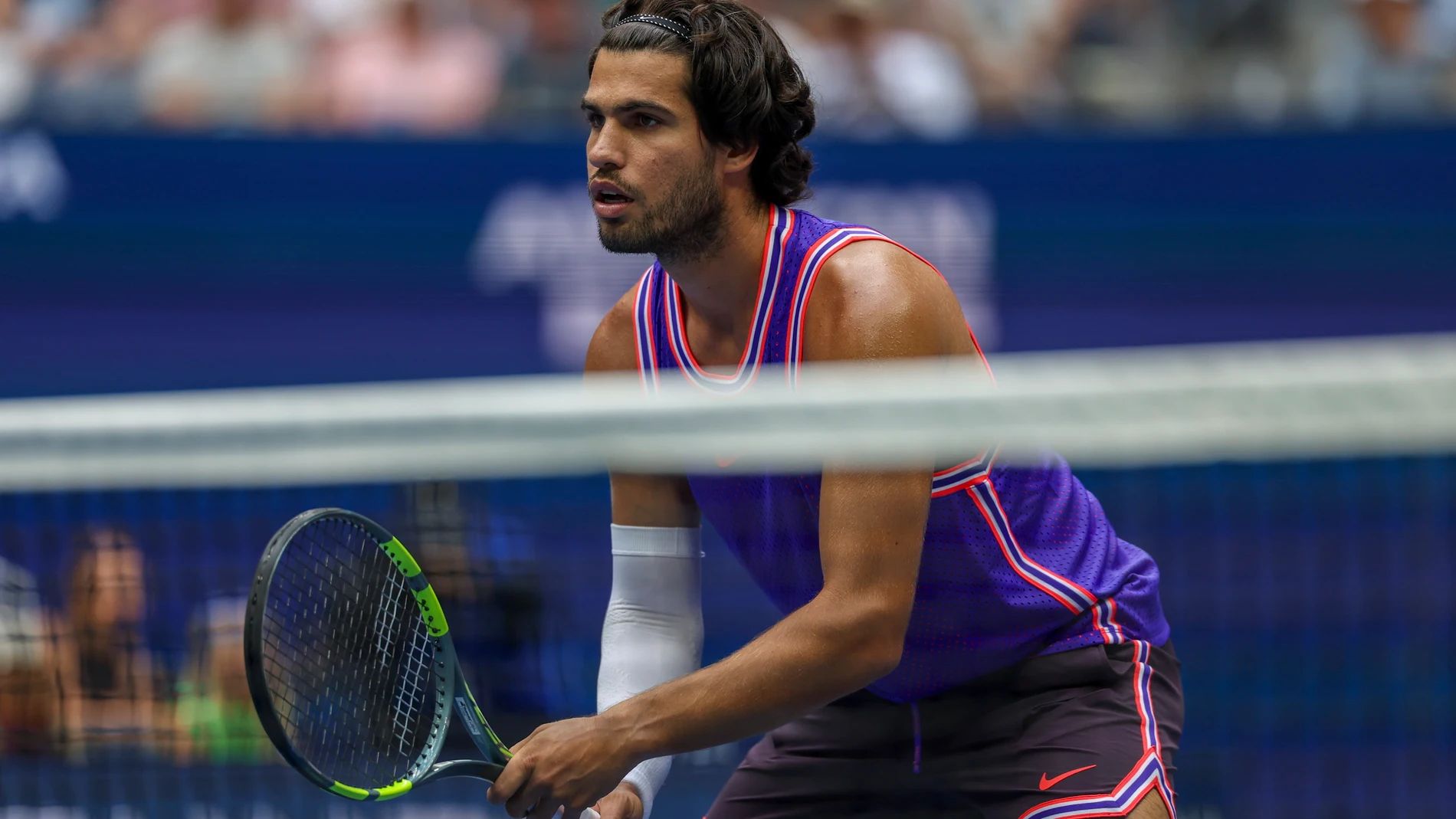
Comeback loading… ⌛ Carlos Alcaraz hitting the practice court ahead of his return to tennis at the US Open The right wrist injury remains the central vulnerability. Alcaraz’s tactical identity relies on generating monstrous topspin from the forehand wing, serving with penetrating pace, and defending dynamically on the stretch. While he has been cleared to play, the structural durability of that wrist has not been tested under genuine competitive strain. Striking thousands of maximal-effort groundstrokes over two weeks will push his physical resilience to its absolute limit.
The tournament landscape shifted dramatically when Jannik Sinner withdrew due to a knee injury. Sinner’s absence removes Alcaraz’s primary modern rival, seemingly clearing a major hurdle. However, this void creates immense opportunity for the rest of the field, increasing the pressure on a rusty defending champion.
Alexander Zverev enters as the No. 1 seed, carrying massive momentum after his Roland Garros triumph and benefiting from a flawless preparation phase. Meanwhile, four-time champion Novak Djokovic lurks as the No. 4 seed. A potential late-round clash with an ultra-experienced, match-sharp Djokovic might ruthlessly exploit any lingering rust in Alcaraz’s game.
Fans received a brief glimpse of Alcaraz’s form when he partnered with Serena Williams in a high-profile mixed doubles return in New York, reaching the quarterfinals before bowing out to Belinda Bencic and Flavio Cobolli. While this offered reassurance that his wrist can handle live serves and volleys, it must be properly contextualized. Mixed doubles cannot simulate the brutal cardiovascular and muscular demands of a grueling singles baseline war.
Carlos Alcaraz possesses more than enough quality, tactical brilliance, and sheer willpower to defend his crown. However, expecting him to immediately resume his pre-injury dominance is unrealistic. His biggest opponent over the next fortnight will not be Zverev or Djokovic, it will be his own lack of competitive match play and physical conditioning. He can win the tournament, but he will have to suffer to do so.
Contenido original de DelDeporte.com · Redacción propia · Política editorial · Correcciones